Modular Messaging: Co-Designing Awareness

Aligning the Irish Cancer Society on core messaging and principles of awareness and prevention, through collaborative workshops.

Role

Service designer

Industry

Public healthcare

Duration

2 months • 2026

Co-design prototyping

Role

Service designer

Industry

Public healthcare

Duration

2 months • 2026

Overview

The Cancer Awareness Team delivers informational presentations to community and corporate audiences on topics such as; men’s health, women’s health, skin cancer etc. The project focused on reviewing and enhancing online presentations for corporate attendees to drive greater impact, engagement, and behaviour change.

Problem

Current presentations achieve high satisfaction rates but have evolved organically, resulting in inconsistent messaging and limited adaptability, falling short of both audience needs for deeper engagement and presenter needs for flexible, maintainable materials.

Solution

Shared consensus on core messaging was crystallised into a modular presentation format, five agreed design principles and presentation guidelines that act as a living reference for future work. This resulted in reduced, more focused presentation slides and shorter presentation times.

From 32 slides…

… down to19!

Goal

To create more impactful presentations and find meaningful ways to deliver key messaging that maximises learning and leads to behaviour change amongst attendees.

Constraints

Tight time constraints required a pivot to a more realistic scope, fully developing one exemplar presentation for corporate attendees to serve as a template for others.

"Sometimes you can get lost in a lot of the stuff... "

"Sometimes you can get lost in a lot of the stuff... "

- Cancer Awareness Team Member

- Cancer Awareness Team Member

Research

To understand the team, their users, the organisation, and the wider ecosystem, research included the following methods:

  • Journey map

  • Channel audit

  • Touchpoint inventory

  • Stakeholder map

  • Current state blueprint

  • Stakeholder interviews

  • Presentation audit

  • Survey analysis (407 responses)

  • Competitor analysis

  • Observation/shadowing

Research methods

Service users

Analysis of 407 survey responses showed most attendees are female-identified, aged 30–50, with a 64% indicative score for behaviour change. Many reported presentations as too long and information-heavy, with requests for guidance for those outside standard screening age groups.

39%

39%

Aged 30 - 50

Aged 30 - 50

58.9%

58.9%

Female identified

Female identified

64%

64%

Indicative behavioural change

Indicative behavioural change

"It was way too long. Talk was scheduled for 30 mins but took over an hour."

"It was way too long. Talk was scheduled for 30 mins but took over an hour."

"It was way too long. Talk was scheduled for 30 mins but took over an hour."

- Feedback survey response

- Feedback survey response

Key insights

Knowledge gaps

Knowledge gaps around screening eligibility.

Too long

Presentations average 30 slides and consistently run for almost an hour.

Misinformation

Widespread misinformation and fear within users' ecosystems of influence.

External barriers

High petrol costs and long waiting lists reducing screening uptake.

Psychological barriers

Users report feeling fearful of cancer with poor risk awareness.

Hypothesis

Hypothesis

Aligned messaging and more engaging presentations will lead to better knowledge recall and behaviour change. A modular, adaptable format will allow the team to present flexibly without diluting their core message.

Co-design workshops

Three workshops addressed knowledge gaps, clarified key messaging, uncovered behaviour change insights, and built team consensus around design principles.

To address the team's knowledge gaps on users, key messaging, behavioural change and consensus on design principles, I devised 3 key co-design workshops.

Empathy mapping and persona

Reflecting on what attendees might be thinking, feeling and seeing about cancer information - an empathy map and persona exercise anchored the team in the user experience.

To address the team's knowledge gaps on users, key messaging, behavioural change and consensus on design principles, I devised 3 key co-design workshops.

Empathy map - attendees

Persona

“We all have our own style, which is good, but can lead to inconsistencies.”

“We all have our own style, which is good, but can lead to inconsistencies.”

“We all have our own style, which is good, but can lead to inconsistencies.”

- Cancer Awareness Team Member

- Cancer Awareness Team Member

Core and supporting messaging

A core and supporting messaging session distilled what the team wanted users to know, feel, and do for each topic.

To address the team's knowledge gaps on users, key messaging, behavioural change and consensus on design principles, I devised 3 key co-design workshops.

Core and supporting messaging: breast cancer

Behaviour change and design principles
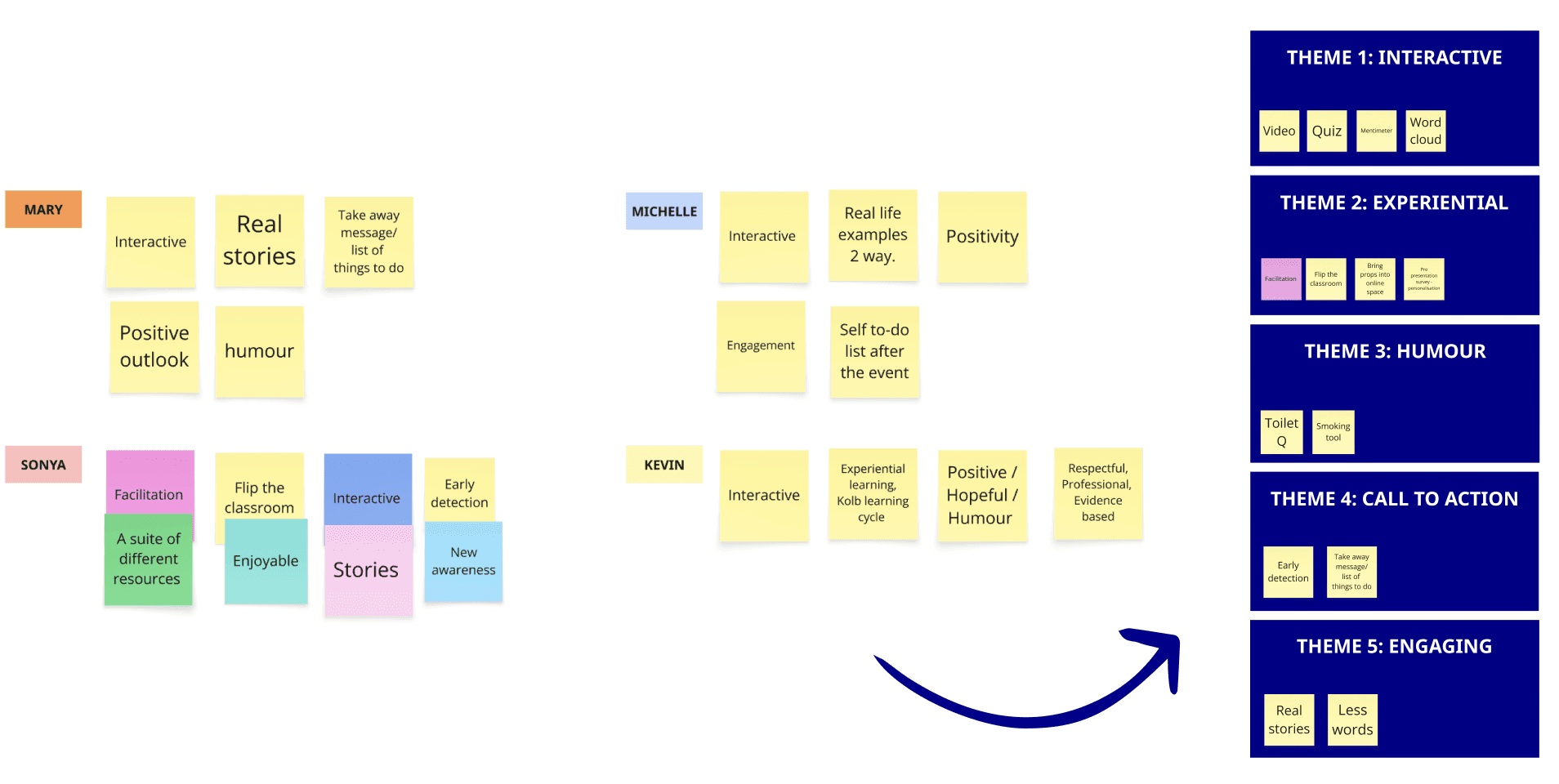
A behaviour change and design principles workshop surfaced five principles the team agreed on: interactive, experiential, humour, call to action, and engaging.

To address the team's knowledge gaps on users, key messaging, behavioural change and consensus on design principles, I devised 3 key co-design workshops.

Design principles

Key insights

Difficulty choosing

The team struggled to commit to a single key message.

Fear of divergence

Some repetition in responses suggested reluctance to diverge from the group.

Interactivity

A clear appetite for interactivity and more engaging elements emerged.

Humour

Humour was identified as a powerful and underused tool for carrying health messaging.

"I would love to have more confidence to use more interactive and engaging tools."

"I would love to have more confidence to use more interactive and engaging tools."

"I would love to have more confidence to use more interactive and engaging tools."

- Cancer Awareness Team Member

- Cancer Awareness Team Member

Ideation

Ideation

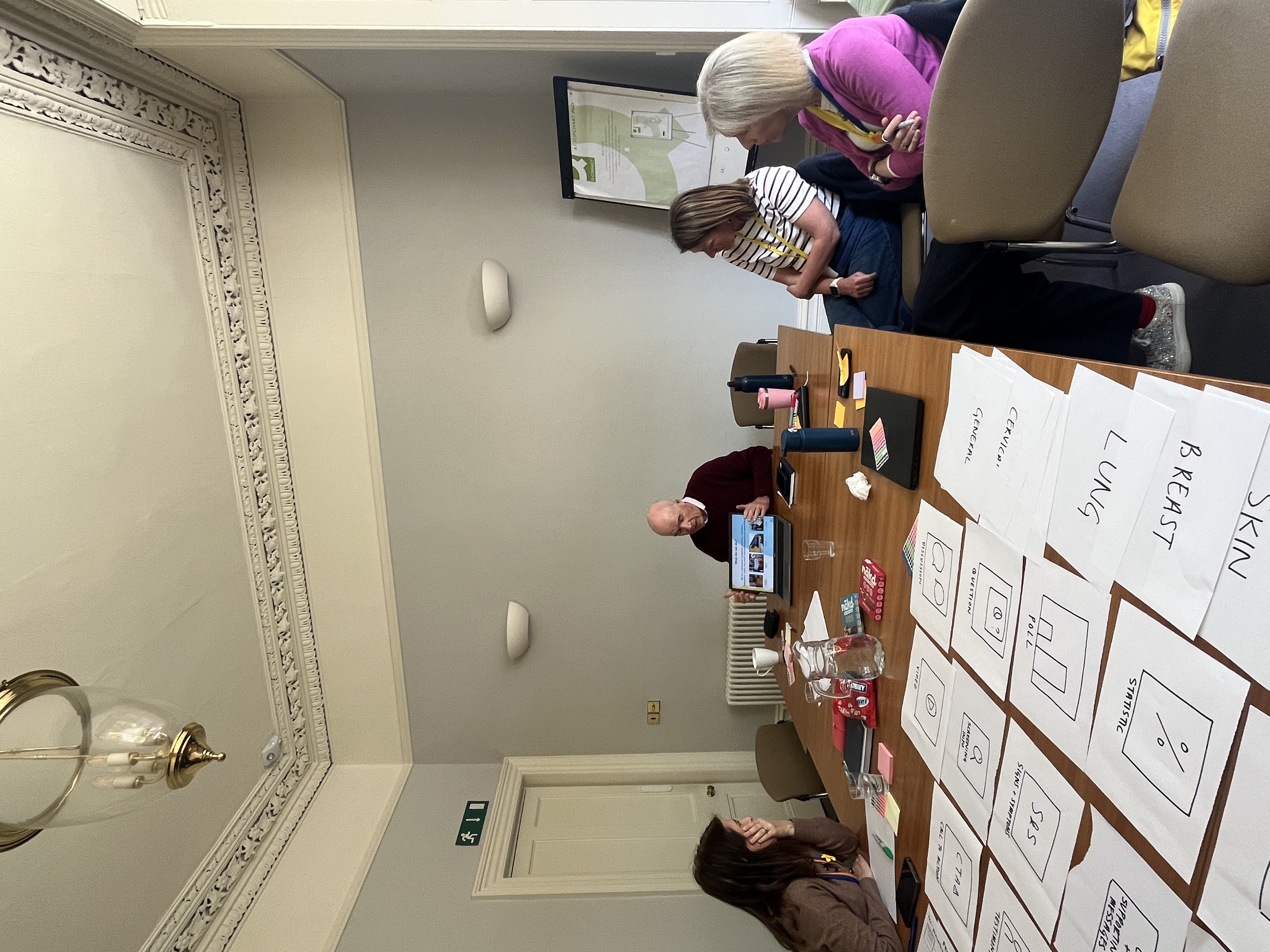
Using the 5 Whys and a How Might We question - how might we instill greater awareness of cancer risks so people take action? - three ideas were generated. Through discussion and prioritisation, a modular format of essential core slides and flexible topic-specific slides was selected for development and testing.
Ideation

Prioritisation
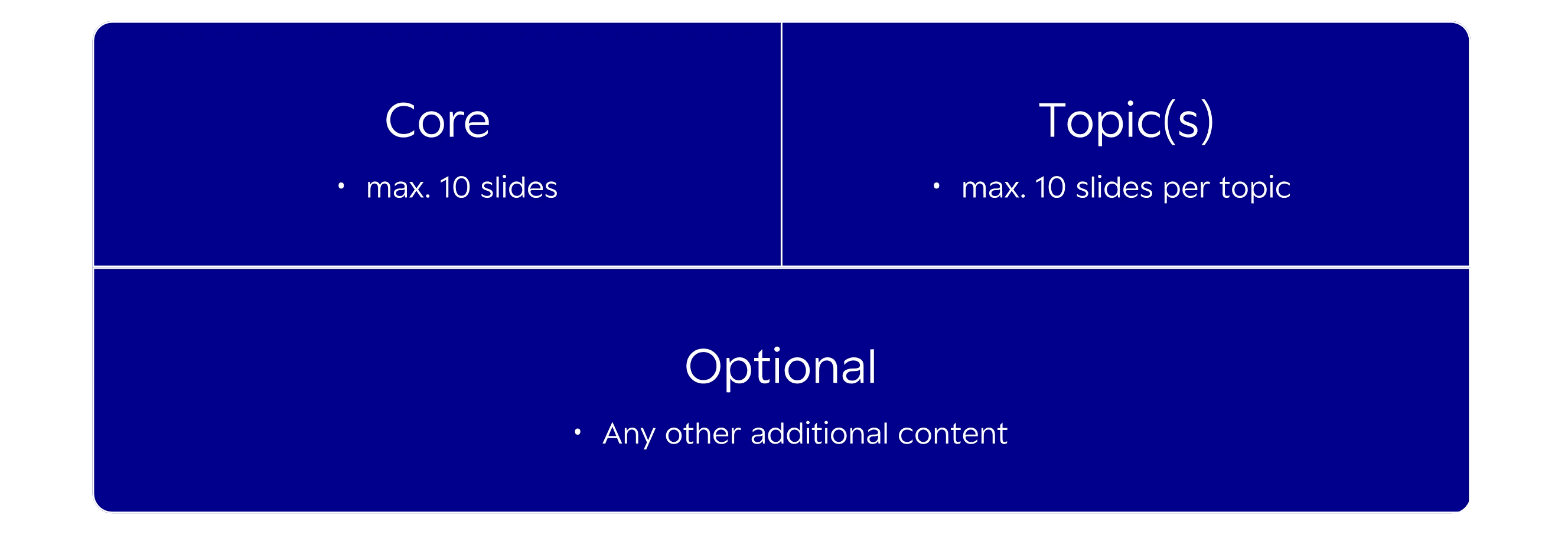
Modular framework

Prototyping

A paper presentation prototype was created with simple sketches of proposed interactive elements. A consensus was reached on a format of 10 core slides, up to 10 topic slides and to include at least one interactive element. The Cancer Awareness manager compiled the prototype, which was reviewed by the team.

Low-fidelity modular prototye: core + topic + interactive element

“You can really see how long the presentations are when they're printed out!”

“You can really see how long the presentations are when they're printed out!”

- Cancer Awareness Team Member

- Cancer Awareness Team Member

User testing

A 30-minute online test was conducted with 4 participants, 3 team members and 1 presenter. The session included 11 core slides with a choice of questions as the interactive element, completing in just over 18 minutes.
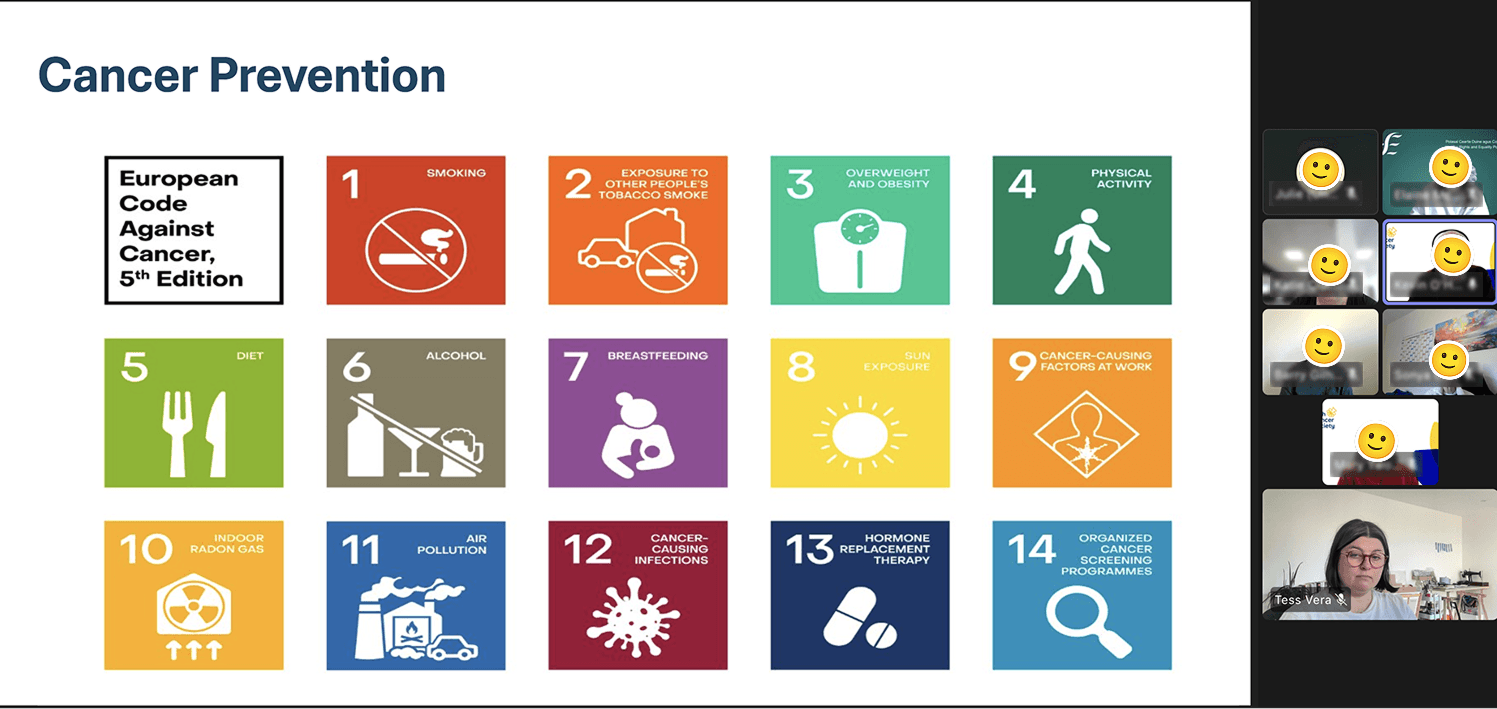
User test

“There was a lot of information and I struggled to understand what the key takeaways were.”

“There was a lot of information and I struggled to understand what the key takeaways were.”

“There was a lot of information and I struggled to understand what the key takeaways were.”

- User feedback

- User feedback

User feedback and team de-brief

One user reported learning something new about HRT, but most felt the slides were too long and expected more cancer-specific content rather than information about the organisation. It became clear in the team de-brief that the presenter - anxious about the time constraints - chose to test only the core slides and included a choice of questions as they felt nervous about asking just one question. They also felt that the testing environment was unnatural and that the questions didn't land well with the group.

Outcomes

Outcomes

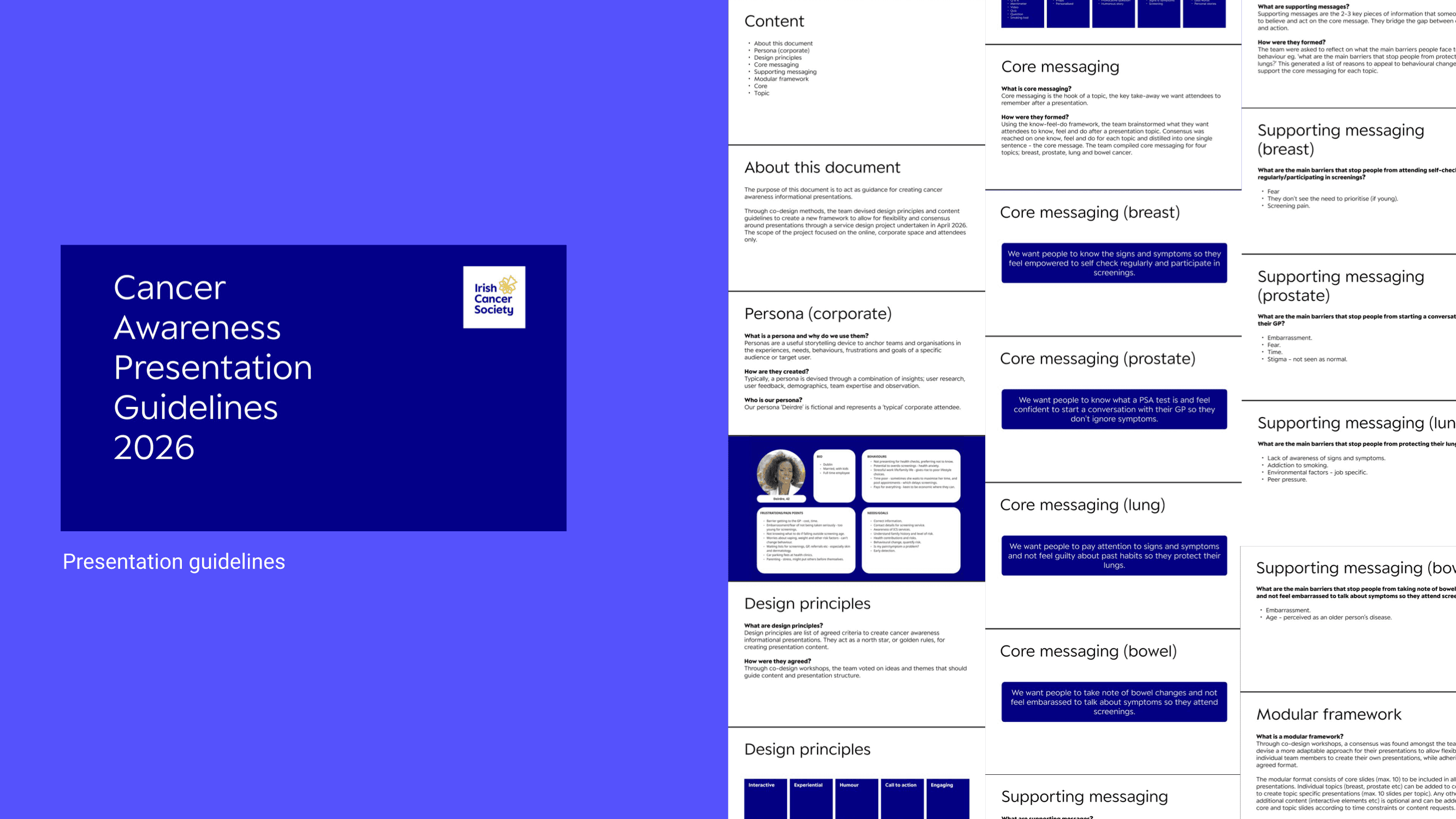
Through co-design, a shared consensus on core messaging was reached for the first time. This was crystallised into a modular presentation format, five agreed design principles and presentation guidelines that act as a living reference for future work. While the full modular concept wasn't fully tested, the process created clarity for the team and the outputs leave them well positioned to inspire preventative behaviour change for thousands of people across Ireland.

Cancer awareness presentation guidelines

Reflection

Reflection

Throughout this project, insights difficult to uncover through research alone, surfaced, giving the team ownership of the outcomes to sustain and build upon. The modular format has strong potential as a scalable blueprint across all topic areas, and the presentation guidelines ensure the work lives beyond the project itself. With more time, it would be valuable to test the complete concept with wider audiences, explore theory of change and role play new formats with the team, and measure the longer-term impact on behaviour change, building on the strong foundation this project has laid.

Other projects

From 32 slides…

… down to 19!

Interested in connecting?

Let’s talk projects, collaborations and opportunities to make a difference.

Book a call

Interested in connecting?

Let’s talk projects, collaborations and opportunities to make a difference.

Book a call

Interested in connecting?

Let’s talk projects, collaborations and opportunities to make a difference.

Book a call

Create a free website with Framer, the website builder loved by startups, designers and agencies.